


Warehouse Liquidations 101: Pallet Racking, Forklifts, and What Buyers Look For
Posted On: August 3, 2026 by Backes Auctioneers in: Auctions Auto and Shop Equipment Downsizing or Liquidating
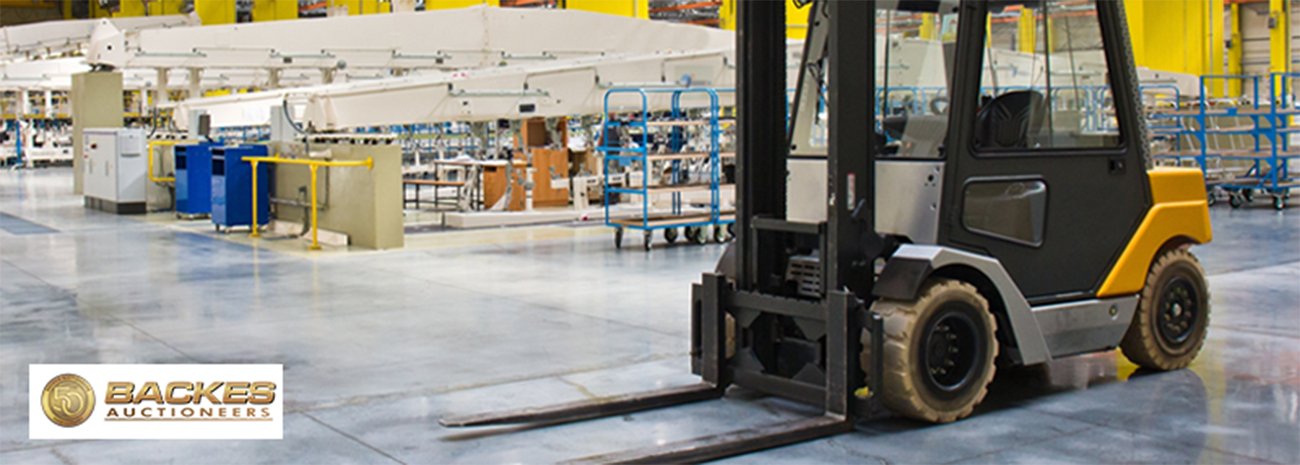
Warehouse operations are always evolving. As layouts change, product lines shift, and handling methods improve, equipment that once made sense may no longer be the best fit for how the business runs today.
That’s where warehouse liquidations often begin — not with a full shutdown, but with a closer look at racking, forklifts, and material handling equipment that no longer supports daily workflows.
For warehouse managers, the opportunity isn’t simply clearing space. It’s identifying assets that still hold resale value and moving them while they may still be useful to another buyer. Pallet racking, forklifts, and handling equipment often lead the list, but condition, documentation, and buyer demand all play a role in how well those assets perform at auction.
This guide walks through how to evaluate common warehouse assets and what buyers tend to look for when equipment comes to auction.
Quick Navigation
- What makes warehouse equipment auction-ready?
- What buyers look for in pallet racking
- When pallet racking is worth selling
- What buyers look for in forklifts and lift equipment
- Material handling equipment that often gets overlooked
- What lowers warehouse equipment value
- How to review your warehouse for sell-ready assets
- How to present warehouse equipment for auction
- FAQs about warehouse liquidations
What Makes Warehouse Equipment Auction-Ready?
You should focus on identifying items that are both replaceable within your operation and appealing to buyers, not just sitting around unused.
Warehouse equipment tends to be a stronger auction candidate when it:
- Has a clear, practical use across multiple industries
- Can be transported, removed, or reinstalled without major complications
- Still operates reliably or can be reasonably repaired
- Comes from a recognized manufacturer or standard system
- Includes accurate information about size, condition, specifications, or included components
Buyers generally come to auctions with specific needs in mind. Some are expanding, some are replacing equipment, and others are outfitting a facility quickly without buying everything new. Equipment that fits into those scenarios may draw more attention because buyers can quickly understand how it could work in their own space.
Related Reading: The Lifecycle of Industrial Machinery: When to Sell at Auction
Pallet Racking: Why It Moves and When It Doesn’t
Pallet racking is one of the most common assets in warehouse liquidations, but buyer interest can vary based on condition, completeness, and how clearly the system is presented.
What Buyers Look for in Pallet Racking
Racking systems are rarely purchased for appearance alone. Buyers are usually focused on compatibility, completeness, and ease of installation.
They’ll typically look for:
- Standard sizing and widely used configurations
- Large runs of matching components
- Minimal damage to uprights, beams, and connectors
- Clear dimensions for uprights, beams, and decking
- Available load capacity information, if known
- Notes about whether wire decking, anchors, or accessories are included
A clean, consistent system is easier for buyers to visualize in a new space. Mixed, incomplete, or heavily modified setups may still sell, but they often require more planning from the buyer.
When Pallet Racking Is Worth Evaluating for Auction
Pallet racking may be worth evaluating for auction when:
- Sections have been decommissioned after a warehouse layout change
- Inventory levels have dropped, leaving unused storage zones
- Older systems have been replaced with higher-density storage
- A facility is consolidating locations or changing workflows
- The system can be removed in complete, functional sections
If the racking can be disassembled into usable sections, it may be worth reviewing for auction rather than treating it as scrap or letting it sit unused.
Forklifts and Lift Equipment: Condition Drives Interest
Forklifts and lift equipment often attract attention because they serve a clear purpose across many types of businesses. However, buyer interest usually depends on how well the equipment has been maintained, documented, and presented.
What Buyers Want to Know About Forklifts
Buyers are less concerned with making a forklift look perfect and more focused on whether it can perform reliably.
Key details include:
- Hours of use
- Service and maintenance history
- Battery condition or engine performance
- Lift capacity
- Mast height
- Fuel type or power source
- Brand reputation and parts availability
- Operating condition at the time of sale
- Known repairs, issues, or limitations
Clear, factual information gives buyers more confidence. When documentation is incomplete, bidders may factor that uncertainty into what they are willing to pay.
Why Timing Matters for Forklifts
Forklifts held too long after being replaced may lose some of their market appeal. Selling while a unit is still in regular rotation, or shortly after it has been retired, usually gives buyers a clearer picture of its condition and use history.
The timing of when you sell the forklift matters. If a forklift still runs, has useful documentation, and no longer supports your workflow, it may be worth evaluating before it sits unused for months or years.
Material Handling Equipment That Often Gets Overlooked
Beyond racking and forklifts, smaller warehouse assets can quietly add value to a liquidation. These items may not always stand out on their own, but they can become more attractive when grouped or presented properly.
Common examples include:
- Pallet jacks and hand trucks
- Conveyor sections and rollers
- Dock equipment, including levelers and plates
- Picking carts and packing tables
- Storage bins, totes, and containers
- Ladders, safety rails, and warehouse accessories
- Stretch wrap machines or packaging equipment
- Shop fans, workbenches, and support tools
Individually, some of these items may not carry much weight. As complete sets or functional groupings, they can be more useful to buyers who are setting up, expanding, or reorganizing an operation.
What Lowers the Value of Warehouse Equipment?
It’s not unusual for equipment to be functional but still struggle to gain traction at auction. In many cases, the issue is not the item itself, but the uncertainty.
A few common issues can limit buyer interest:
- Incomplete systems that are missing key components
- Specialized configurations that do not easily transfer to other operations
- Poor documentation, especially with powered equipment
- Deferred maintenance that creates uncertainty around condition
- Unclear dimensions, capacities, or included parts
- Difficult removal requirements
- Equipment that has been stored too long without inspection or maintenance
Buyers factor in time, cost, and risk. If equipment adds complexity or leaves too many unanswered questions, it may narrow the pool of potential bidders.
Read More: Bundle vs. Sell Individually: How to Choose the Best Lot Strategy
How to Review Your Warehouse for Sell-Ready Assets
A structured walkthrough keeps the process focused without disrupting daily operations. Start by looking at how your space is actually being used today.
Storage Areas
Review your racking, shelving, and storage zones.
Look for:
- Racking that is no longer part of active workflows
- Empty or underutilized zones that have stayed that way
- Mixed or partial racking systems that could be consolidated
- Storage areas created for product lines you no longer carry
- Older systems that have been replaced by newer layouts
Equipment Fleet
Review forklifts, lift trucks, and other powered equipment.
Look for:
- Units that are consistently used
- Units that serve as backups but rarely see operation
- Equipment replaced by newer models
- Forklifts with maintenance records or known service history
- Lift equipment that no longer fits your facility layout or workflow
Support Equipment
Review the smaller items that support movement, storage, packing, and shipping.
Look for:
- Conveyors, carts, and dock equipment not tied to current processes
- Duplicate or excess items that do not add operational value
- Packaging or storage equipment left from past workflows
- Complete sets of smaller items that could be grouped for sale
The goal is to match what you own to how your warehouse operates today, not how it operated a few years ago.
How to Present Warehouse Equipment in a Way That Attracts Buyers
Once you’ve identified assets to sell, presentation plays a larger role than many sellers expect. Buyers don’t need a sales pitch. They need clarity.
Focus on:
- Accurate descriptions, including condition and specifications
- Clear photos that show the actual equipment
- Notes about included components, accessories, or missing parts
- Grouping related items into complete, usable sets
- Disclosing known issues upfront
- Making removal requirements clear when needed
Transparent listings help buyers make faster, more confident decisions. That confidence can support stronger participation because bidders have a clearer understanding of what they are buying.
If you already know you have warehouse equipment ready to move, Backes can help you take the next step.
Deciding What to Sell Now vs. Hold
Not every piece of equipment needs to move immediately. A practical approach is to separate assets into two groups: items that are strong immediate candidates and items that may be better held for now.
Strong Immediate Candidates
These are items that may be worth preparing for auction sooner:
- Equipment that no longer supports current workflows
- Complete systems that are ready for reuse
- Items with broad appeal and standard configurations
- Forklifts or lift equipment with clear condition details
- Material handling items that can be grouped into useful lots
Better Held for Now
These items may need more review before selling:
- Equipment tied to seasonal demand
- Assets with uncertain near-term use
- Items that would benefit from minor repairs or cleanup
- Partial systems that could be consolidated with matching components
- Equipment that needs additional documentation before listing
This distinction prevents over-selling while still capturing value where it exists.
Turn Unused Warehouse Equipment Into a Clear Opportunity
Warehouse liquidations don’t always happen because of a major business change. In many cases, they’re the result of gradual operational shifts, such as updated layouts, upgraded equipment, changing workflows, or storage systems that no longer fit the way the business runs today. Over time, assets that once supported daily work can become excess without anyone noticing right away.
That leftover equipment may still carry value. The key is recognizing when that value is better realized outside your operation.
A clear, methodical review helps turn unused warehouse equipment into a defined opportunity instead of a gradual buildup of assets that take up space. When you understand what buyers look for, you can make better decisions about what to keep, what to prepare, and what may be ready to sell.
If you’re still deciding whether certain items are worth bringing to auction, a second opinion on market demand can help clarify your next step. Contact Backes Auctioneers today for help evaluating your warehouse equipment.
Talk to Backes About Your Equipment
FAQs About Warehouse Liquidations
What warehouse equipment typically sells best at auction?
Warehouse equipment with broad, practical use tends to attract buyer interest. Common examples include pallet racking, forklifts, pallet jacks, conveyor sections, dock equipment, carts, bins, and other material handling items that can be used across many types of operations.
Does pallet racking need to be a complete system to sell?
Pallet racking does not always need to be a complete system, but complete sections with matching components are usually easier for buyers to understand, remove, and reinstall. Clear dimensions, condition notes, and included components can help buyers evaluate whether the racking will work for their facility.
What information should I provide when selling pallet racking?
Helpful pallet racking details include upright height and depth, beam length, decking type, number of sections, visible condition, included accessories, and any available load capacity information. If load ratings are unknown, it is better to be transparent than to guess.
How important is forklift maintenance documentation?
Forklift maintenance records are not always required, but they can help build buyer confidence. Service history, hours of use, battery or engine condition, lift capacity, and known issues all help buyers understand the equipment’s condition before bidding.
Should smaller warehouse items be sold individually or grouped?
Smaller warehouse items often perform better when grouped into functional sets. Pallet jacks, carts, bins, conveyor pieces, packing tables, or dock accessories may be more useful to buyers when they are presented as practical lots instead of scattered individual items.
When is the right time to sell warehouse equipment?
The right time to sell is usually when the equipment no longer supports current operations but is still usable, understandable, and in marketable condition. Waiting too long can create uncertainty around condition, maintenance, or completeness.
How do I know if my warehouse equipment is auction-ready?
Warehouse equipment may be auction-ready if it has a clear use, can be removed without major complications, includes accurate condition details, and may appeal to buyers outside your current operation. Standard configurations, complete systems, and recognizable brands can also make equipment easier for buyers to evaluate.

0 comments